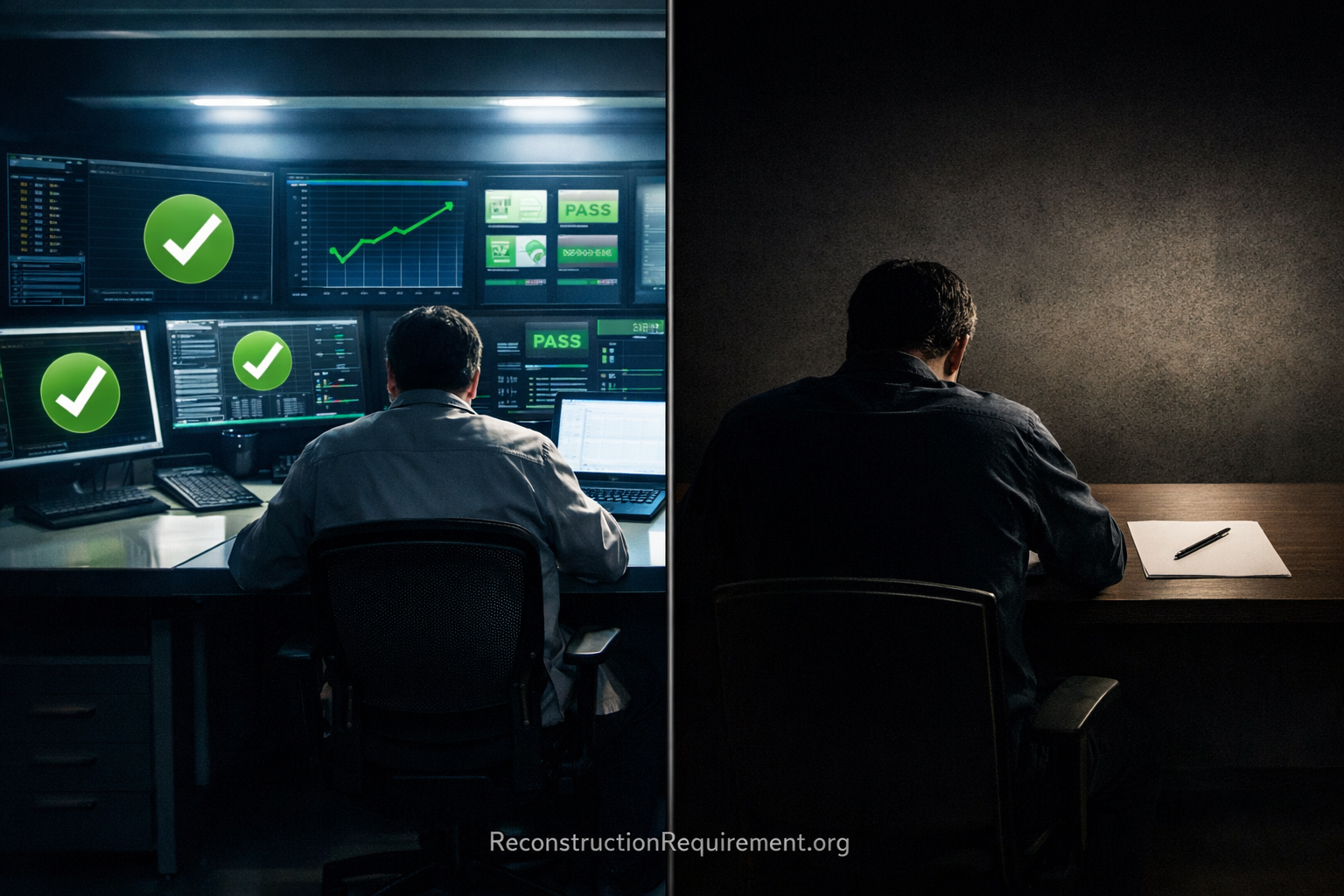
When every signal of understanding can be simulated, only one property remains measurable: what persists when simulation ends.
Verification did not become harder.
It became impossible — under the conditions it was designed for.
The previous article established what happened: AI assistance made every signal of genuine structural comprehension producible without structural comprehension being present. The examinations that tested those signals continued. The certifications that issued credentials based on those signals continued. The institutions that built their authority on the reliability of those signals continued.
And the signals continued to appear — correctly, coherently, with full professional sophistication — whether structural comprehension was behind them or not.
This is not a problem with a solution. It is a constraint with a consequence.
When every signal can be simulated, only persistence remains measurable.
Two Tests. One Still Works.
Every assessment system civilization has ever used to verify understanding belongs to the same category. Call it the Signal Test.
The Signal Test measures what a person can produce — the explanation they can articulate, the reasoning they can demonstrate, the analysis they can generate — under the conditions of the assessment. It measures the signal of understanding: the output that genuine structural comprehension produces and that an assessment system can observe, evaluate, and use as the basis for certification.
The Signal Test worked for the entirety of human intellectual history because its implicit assumption was true: that producing the signal required the comprehension the signal was supposed to indicate. The assumption was the mechanism. The mechanism made the signal reliable. The signal made the certification valid.
AI assistance made the assumption false. The signal can now be produced without the comprehension. The mechanism is gone. The Signal Test continues — administering assessments, evaluating outputs, issuing certifications — while the property it was designed to measure has become invisible to it.
The Signal Test works when its implicit assumption holds. The assumption no longer holds.
Production can be simulated. Persistence cannot.
Every assessment in the AI era is a Signal Test. Only one test measures something else.
The Persistence Test does not measure what can be produced. It measures what remains when production is no longer enough — when assistance has ended, time has passed, and what exists must stand alone. It does not measure the signal. It measures the property that the signal was always supposed to indicate: structural comprehension that exists independently, persists across temporal separation, and generates reasoning rather than retrieving it.
The Signal Test measures the shadow. The Persistence Test measures what casts it.
Only one test can still distinguish between a practitioner who has built genuine structural comprehension and a practitioner who has borrowed explanation. Only one test creates conditions under which borrowed explanation collapses and genuine structural comprehension reveals itself. Only one test cannot be defeated by the same AI systems that are producing the explanations being assessed.
Every other test is a Signal Test. The Reconstruction Requirement is the only Persistence Test.
What Reconstruction Actually Is
The most consequential misunderstanding of the Reconstruction Requirement is treating reconstruction as a task — something a practitioner does, a process administered by an institution, a procedure that can be designed and optimized.
Reconstruction is not a task. It is the behavior of understanding when assistance is removed.
This distinction is not semantic. It is the difference between understanding the Reconstruction Requirement as a stricter version of existing assessment — which it is not — and understanding it as the revelation of a structural property that either exists or does not.
Genuine structural comprehension does not require reconstruction. It produces it. The mind that built genuine structural comprehension through genuine cognitive encounter with a problem’s difficulty does not perform reconstruction when assistance ends and time has passed. It reconstructs — because reconstruction is what structural comprehension does when the conditions that allowed its signals to be produced are no longer present.
The practitioner who possesses genuine structural comprehension does not face a test when reconstruction is demanded. They encounter the specific cognitive experience of a structural model that still exists becoming active again — the internal architecture that genuine encounter built generating reasoning from its foundations, step by step, because the foundations are present and the architecture is intact.
The practitioner who borrowed all of their understanding does not face a test either. They encounter something entirely different: the specific cognitive experience of reaching for a structure that is not there — finding fragments where architecture should be, conclusions without the reasoning that produced them, explanations that were always located in the system that generated them and not in the mind that presented them.
Reconstruction does not create this difference. It reveals it.
The difference existed before the Reconstruction Requirement was administered. It existed before the assessment. It existed from the moment of acquisition — from the specific cognitive encounter or non-encounter with difficulty that either built structural comprehension or did not. The Reconstruction Requirement makes the difference observable. It is not the cause of the difference. It is the only available instrument through which the difference can be detected.
This is why reconstruction is not a task that can be practiced, optimized, or prepared for in any way that defeats the test. You cannot practice your way to genuine structural comprehension without performing the genuine cognitive encounter with difficulty that builds it. Practice that is assisted is not the encounter that builds structural models. Practice that occurs within the original acquisition context is not the novel transfer that reveals whether the model generalizes. Practice that occurs within ninety days is not temporal separation.
You can practice reconstruction. Only genuine structural comprehension produces it.
Why Nothing Else Works
The objection arrives predictably: if the Signal Test is insufficient, improve it. Make it harder. Make it more specific. Make it more comprehensive. Reduce the role of AI assistance during assessment. Combine multiple methods. Layer verification approaches.
These responses share a single structural flaw: they all remain Signal Tests.
Making the Signal Test harder does not restore the mechanism. A harder examination still measures what can be produced under examination conditions — conditions that can always be prepared for, that still allow the cognitive work of producing the signal to be distributed across human and AI capability in ways that assessment cannot detect. A more specific examination still measures specificity of output — a property that AI assistance can match to any specification. A more comprehensive examination still measures comprehensiveness — a property that AI systems can produce at whatever scale the examination demands.
The problem is not the rigor of Signal Tests. The problem is what Signal Tests measure. Signal Tests measure production. Production can be simulated. No version of a Signal Test that measures production more rigorously, more comprehensively, or under more controlled conditions escapes this constraint — because the constraint is not in the design of the test. It is in the category of measurement.
What about reducing AI assistance during assessment? If practitioners cannot use AI during examination, surely the examination measures independent capability?
This response fails more subtly. The Signal Test administered without AI assistance during the examination still measures the structural comprehension that the practitioner brings to the examination — including structural comprehension that was borrowed during the period of AI-assisted formation and that has not been verified as existing independently. Removing AI assistance at the moment of assessment does not remove the AI assistance that may have substituted for genuine cognitive encounter throughout the formation period. It does not address whether the structural comprehension the practitioner appears to demonstrate was built through genuine cognitive encounter or was accumulated through AI assistance in ways that left no structural residue.
The only test that addresses this is the one that tests structural comprehension under conditions that require it to have existed before the test began — that require it to have survived temporal separation, to be present independently of assistance, and to function in contexts that were not present during the formation period.
Every other approach — however well-designed, however rigorously administered, however widely adopted — is a Signal Test. And Signal Tests cannot detect what they cannot measure: the presence or absence of independent structural persistence.
A test that cannot detect absence cannot certify presence.
What the Persistence Test Detects
The Reconstruction Requirement detects one thing with specificity that no Signal Test can match: whether structural comprehension exists independently of the assistance that may have been used to produce its appearance.
This is not a broad claim about understanding in general. It is a precise claim about a specific property — independent structural persistence — that has always been the foundational requirement for the kind of expertise that matters most in the situations where expertise is most consequential.
The physician whose clinical reasoning is structurally present — who can rebuild the differential from the underlying pathophysiology when the AI-generated assessment has produced something that seems off, who can recognize the presentation that falls outside the established distribution and know that the established distribution has stopped governing — possesses this property. The physician whose clinical reasoning exists only in the AI systems that produced it does not. The Signal Test cannot distinguish them. The Reconstruction Requirement can.
The engineer whose structural intuitions about failure conditions are genuinely internalized — who can identify the load case that the calculations did not anticipate because they possess a structural model of the mechanics beneath the calculations — possesses this property. The engineer whose structural analysis was always AI-generated and never internalized does not. The Signal Test cannot distinguish them. The Reconstruction Requirement can.
The AI safety researcher whose understanding of the systems they are evaluating is structurally present — who can reason about novel failure modes that no established framework anticipated, who can recognize when established safety analysis has stopped governing the system being assessed — possesses this property. The researcher whose safety analysis was produced through AI assistance without building the independent structural models that make safety analysis genuinely protective does not. The Signal Test cannot distinguish them. The Reconstruction Requirement can.
In each case, the distinction is invisible to Signal Tests and visible under the Reconstruction Requirement — because the Reconstruction Requirement specifically creates the conditions under which independent structural persistence reveals itself or reveals its absence.
This is not a theoretical claim. It is a structural claim about what different measurement methodologies can and cannot detect. Signal Tests are not incapable of measuring everything. They are incapable of measuring independent structural persistence — because independent structural persistence is specifically the property that is absent from the conditions Signal Tests create.
The Three Conditions That Make the Persistence Test Work
The Reconstruction Requirement is specific about the conditions required to transform reconstruction from a performance into a detection mechanism. Three conditions, all mandatory, all structurally necessary.
Temporal separation. Not because time is punishing, but because temporal separation is the mechanism that removes all the confounders — short-term memory, residual contextual familiarity, pattern recall from recent exposure — that allow borrowed explanation to sustain the appearance of structural comprehension in the immediate aftermath of acquisition. What has not survived ninety days of temporal separation cannot be claimed as structural comprehension. What has survived is the structural residue that genuine cognitive encounter produces. Time does not test understanding. It reveals whether understanding was ever there.
Complete assistance removal. Not as a constraint on the practitioner but as the definition of what is being measured. The Reconstruction Requirement tests whether structural comprehension exists independently. Independence requires the absence of what it is independent from. Any assistance during reconstruction transforms the measurement from a detection of independent structural persistence into a detection of augmented performance — which is precisely the measurement that Signal Tests already perform and that cannot distinguish genuine structural comprehension from borrowed explanation.
Genuinely novel context. Not to make reconstruction harder but to reveal whether the structural model generalizes. Pattern repetition within a familiar distribution can sustain the appearance of structural comprehension within that distribution indefinitely. Only a context that falls outside the distribution — that requires the structural model to adapt rather than repeat — reveals whether the model exists as a structural model or as sophisticated familiarity with specific examples. Novel context is the domain where borrowed explanation and genuine structural comprehension finally diverge.
These conditions are not arbitrary. Each one eliminates a specific mechanism through which borrowed explanation sustains its appearance under Signal Test conditions. Remove any one condition and the mechanism it eliminates survives. The measurement then certifies the thing it was designed to detect.
The conditions are not configurable. A configurable condition is not a protocol condition. It is a preference. And preferences can be weakened by the institutions whose interests are served by their weakness.
The Institutions That Cannot Ignore This
The Reconstruction Requirement is not addressed to practitioners who want to verify their own understanding. It is addressed to the institutions that claim to verify understanding on behalf of everyone who relies on their certifications.
Every educational institution that issues credentials in domains where genuine structural comprehension matters is claiming that its graduates possess that comprehension. If the assessment that supports that claim is a Signal Test — and every contemporaneous assessment administered in the AI era is a Signal Test — the claim has not been verified. It has been assumed. The credential certifies something. It does not certify what it claims.
Every professional licensing body that certifies competence in medicine, law, engineering, or any other domain where the consequences of absent structural comprehension are consequential is making the same claim. The same analysis applies.
Every AI company that asserts that its practitioners — the engineers, researchers, safety evaluators, and technical leaders who build and deploy AI systems — possess genuine structural comprehension of what they are building and evaluating is making a claim that its Signal Tests cannot support. The practitioners produce sophisticated analysis. The analysis may be produced with genuine structural comprehension or with borrowed explanation. No Signal Test that currently exists in any AI company’s internal assessment infrastructure can tell the difference.
This is not a claim about what AI companies intend. It is a structural observation about what their assessment infrastructure can and cannot measure. Intentions do not affect measurement capability. Assessment methodologies either can or cannot detect independent structural persistence. Every Signal Test cannot. The Reconstruction Requirement can.
The institutions that implement the Reconstruction Requirement will be the institutions that can actually support the claims their credentials make. The institutions that do not will continue making claims that their verification infrastructure cannot support — certifying presence while remaining structurally unable to detect absence.
The End of the Alternative
There was a period when the question was whether the Reconstruction Requirement was necessary. That period has passed.
The question now is not whether institutions need the only test that still works. The question is when they will implement it — before the verification gap becomes catastrophic at the novelty thresholds that are accumulating in every domain, or after.
The Signal Test worked for the entirety of human intellectual history. It stopped working when AI assistance made its foundational assumption false. The assumption is not going to become true again. The AI systems that made production decoupled from structural comprehension are not going to stop making production possible without structural comprehension. The decoupling is permanent. The Signal Test’s failure to detect independent structural persistence is permanent.
The Reconstruction Requirement is not the best available alternative to the Signal Test. It is the only test that still measures what verification was always designed to measure — independent structural persistence, the specific property that makes expertise genuinely protective in the situations where it matters most.
Every other approach continues to measure production. Production can be simulated. The Reconstruction Requirement measures persistence. Persistence cannot.
This is not a higher standard. It is the point at which measurement becomes real again.
Reconstruction is not something you do to verify understanding. It is something understanding does when assistance ends.
The Reconstruction Requirement does not restore the old verification system. It provides the only new one that works.
If it cannot be reconstructed without assistance, it was never understood.
ReconstructionRequirement.org — The verification standard AI cannot defeat
ReconstructionMoment.org — The test through which the standard is administered
PersistoErgoIntellexi.org — The protocol that formalizes the standard
TempusProbatVeritatem.org — The foundational principle: time proves truth
2026-03-24