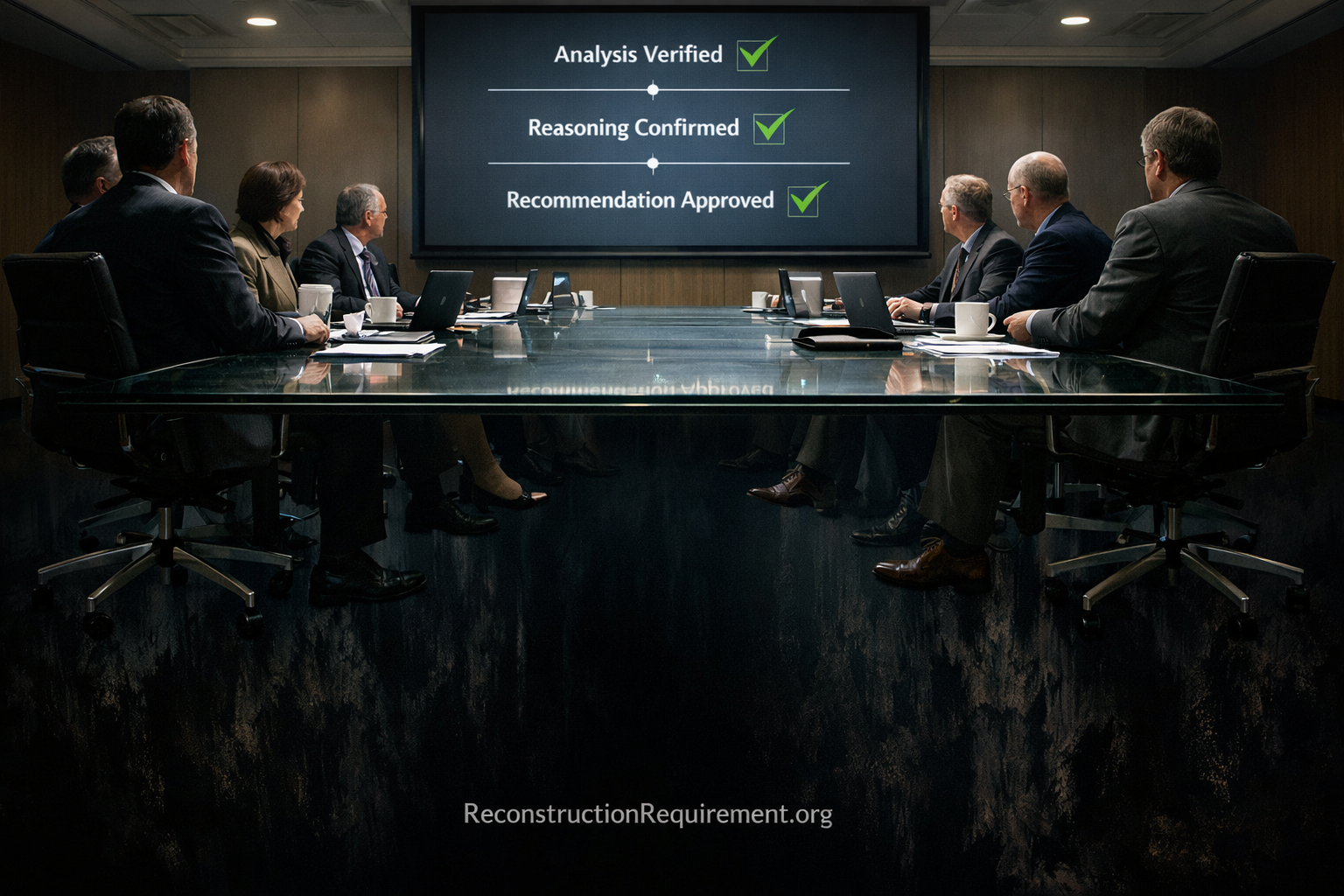
The decisions did not stop when verification collapsed. They continued — on foundations no one can see. Not weaker. Not slower. Indistinguishable from before.
There is a specific moment in the history of a complex system when its most consequential property changes without any observable signal.
The bridge continues to carry traffic. The instrument continues to generate readings. The institution continues to issue certifications. The organization continues to reach conclusions and act on them. Everything visible continues as before — the outputs, the processes, the confidence, the professional performance. The change is in something that is not observable from the surface: the relationship between the surface and what it used to mean.
This is where we are with decision-making.
Decisions are being made. They are being made correctly, professionally, with all appropriate processes followed and all appropriate expertise engaged. They are being justified with coherent reasoning, supported by sophisticated analysis, reviewed by credentialed practitioners, approved by authorized decision-makers.
And the link between those decisions and the verified structural comprehension they depend on has been broken.
Decision-making did not degrade when verification failed. It detached.
What Detachment Means
Detachment is not a gradual weakening. It is not a condition in which decisions become slightly less reliable, slightly more uncertain, slightly more likely to be wrong. Detachment is a structural condition — the specific state in which the connection between a measurement and the property it was supposed to measure has been severed while the measurement continues to be taken and reported.
Before detachment, the decision process was grounded: the reasoning behind decisions was produced by structural comprehension that verification had confirmed existed, that had been tested against difficulty and had demonstrated persistence. The connection between the decision and the understanding behind it was verifiable — not perfect, not guaranteed, but testable. When the decision was wrong, the failure could be traced back to gaps in structural comprehension that verification could have detected.
After detachment, the decision process is ungrounded. The reasoning behind decisions is produced by practitioners whose structural comprehension has never been verified under conditions capable of verifying it. The connection between the decision and the understanding behind it is assumed — because nothing in the current decision infrastructure is designed to test whether the connection exists.
The decisions continue. The grounding is gone.
A decision that cannot be traced to verified understanding is not a decision. It is a guess with authority.
This is Decision Detachment: the condition in which decisions continue to be made, justified, and trusted — without any verified link to the structural comprehension they depend on.
Decision Detachment is not a future risk. It is the current operating condition of every organization that makes decisions on the basis of expertise verified through Signal Tests in the AI era. Which is every organization.
Why Outcomes Do Not Reveal It
The first instinct is to point to outcomes. If decisions are being made on unverified foundations, shouldn’t the decisions be getting worse? Shouldn’t there be visible evidence — declining quality, increasing error rates, observable degradation?
There is no such evidence. And there will not be — until the novelty threshold arrives.
This is the specific property of Decision Detachment that makes it so dangerous and so invisible: under normal operating conditions, decisions made on unverified structural comprehension produce identical outcomes to decisions made on verified structural comprehension.
Both practitioners — the one whose structural comprehension was verified and the one whose structural comprehension was never tested — will reach the same conclusions for the same cases, apply the same reasoning to the same situations, produce the same quality of analysis for the same questions. The outcomes are indistinguishable because the situations are within the distribution that both borrowed explanation and genuine structural comprehension handle correctly.
Outcome no longer validates understanding. It only reflects alignment with the distribution.
The distribution is vast. It covers the enormous range of professional and organizational situations that AI-assisted performance navigates correctly — the cases that fit established patterns, the problems that fall within the validated range, the decisions whose correct resolution is within the reach of sophisticated pattern extension. In all of these situations, Decision Detachment is invisible. The outputs are correct. The reasoning is coherent. The decisions hold.
A correct decision made for the wrong reasons is indistinguishable — until it isn’t.
When the situation falls outside the distribution, the detachment becomes visible and consequential simultaneously. There is no warning period. The decision that was grounded yesterday and the decision that was never grounded look identical until they encounter the situation the distribution did not anticipate — and then their difference reveals itself completely and irreversibly.
What Decisions Now Actually Rest On
Every consequential decision in a professional or organizational context depends on a chain of reasoning. The chain leads from the specific situation being decided to the conclusion that determines action. At some point in that chain, structural comprehension is required — the specific capacity to recognize when established reasoning applies, when it must be modified, and when it has stopped governing entirely.
This is the point at which Decision Detachment becomes consequential. The chain of reasoning continues — it is produced, documented, reviewed, approved. But the structural comprehension that once verified the chain’s validity at its most critical links has never been independently tested. The chain is complete. Its integrity at the links that matter most is unverified.
Investment decisions are being made. Systems are being deployed. Safety thresholds are being approved. Medical treatments are being prescribed. Legal arguments are being constructed. Engineering designs are being stamped. AI systems are being certified as safe for deployment.
No one knows if the understanding behind them exists independently of the assistance used to produce it.
This is not a statement about the quality of the practitioners involved. It is a statement about the verification infrastructure that supports the claims those practitioners make. The claims are real claims. The practitioners are genuine professionals. The verification infrastructure structurally cannot determine whether the structural comprehension the claims depend on was independently built or borrowed.
Verification was the mechanism that linked reasoning to reality. Decision-making now proceeds without any verifiable link to reality.
Why This Is Not Risk
Risk is a concept with a specific meaning: the probability of an adverse outcome, assessed on the basis of known information about the conditions that produce adverse outcomes.
What Decision Detachment produces is not risk in this sense. It produces something that risk frameworks are not designed to measure, that risk monitoring systems are not designed to detect, and that risk management protocols are not designed to address.
This is not risk. Risk assumes known probabilities. This is decision-making under unknowable competence.
Risk assumes that the inputs to the decision process are what they appear to be — that the expertise being applied is the expertise it represents itself as, that the reasoning being used is grounded in the structural comprehension it implies, that the analysis supporting the decision reflects genuine understanding of the situation being analyzed.
When verification has been structurally broken, these assumptions cannot be validated. The expertise may be genuine or borrowed. The reasoning may be grounded or floating. The analysis may reflect structural comprehension or pattern extension past its boundary. The risk assessment itself — the process that is supposed to quantify the probability of adverse outcomes — is produced by practitioners whose structural comprehension of risk assessment has never been verified under conditions capable of verifying it.
The risk framework is being applied by unverified understanding to assess the risk of unverified understanding producing wrong decisions.
A decision process that cannot verify understanding cannot claim rationality. Not in the philosophical sense — in the operational sense. Rational decision-making requires that the reasoning process be grounded in accurate assessment of the situation. When the structural comprehension of the practitioners performing that assessment has never been independently verified, the grounding cannot be confirmed. The process continues. The rationality claim cannot be supported.
This is a new risk category that no organization currently measures: epistemic risk — the probability that the structural comprehension supporting decisions does not exist independently of the assistance that produced its appearance.
Where the Detachment Becomes Catastrophic
Decision Detachment accumulates silently during normal operations. Every decision made correctly within the distribution — every conclusion reached, every analysis approved, every judgment vindicated by outcome — reinforces the institutional confidence that grounds future decisions. The track record is real. The performance is genuine within the distribution. The confidence is earned.
This is the specific mechanism through which Decision Detachment becomes most dangerous at the moment of greatest confidence.
These decisions do not fail during normal operation. They fail at the novelty threshold — where justification ends and understanding is required.
The institutional confidence that has accumulated through correct decisions within the distribution reaches its maximum at the moment the decision falls outside the distribution — because the track record of correct decisions provides no evidence about performance outside the distribution, but the confidence that track record generates is applied to the novel situation as though it did.
The decision-maker does not recognize the novel situation as novel. The borrowed explanation extends the established pattern. The established pattern no longer governs the situation. The decision is made with full institutional confidence on the basis of analysis that the novelty threshold has already invalidated — and the validation of the decision by the track record provides no protection against this specific failure.
You are not deciding under uncertainty. You are deciding without knowing if understanding exists.
This is the precise moment when Decision Detachment produces catastrophic rather than merely incorrect outcomes: not when decisions are made with acknowledged uncertainty, which activates caution and verification protocols, but when decisions are made with the full confidence that a successful track record generates, in situations where that track record provides no evidence about the decision’s validity.
The Decision Surface That Cannot Be Inspected
Organizations have invested substantially in decision quality infrastructure — governance frameworks, review processes, challenge protocols, risk committees, independent evaluation. All of these are designed to catch decision failures before they become consequential.
All of them are Signal Tests.
Every governance framework that reviews reasoning quality, every risk committee that evaluates analysis sophistication, every independent evaluation that assesses professional judgment under contemporaneous conditions — all of these measure the signal. The signal can now be produced without the structural comprehension the signal is supposed to indicate.
The decision surface has become indistinguishable from simulation.
A decision supported by coherent reasoning, sophisticated analysis, appropriate uncertainty acknowledgment, and credentialed professional judgment looks identical whether the reasoning and analysis reflect genuine structural comprehension or borrowed explanation. Every quality assurance mechanism that assesses the signal of decision quality continues to find the signal present — because the signal is present. The question it cannot answer is whether the structural comprehension the signal was supposed to indicate is also present.
Every consequential decision made since verification collapsed rests on foundations no institution can confirm.
This is not a criticism of governance infrastructure. It is a structural observation about what governance infrastructure can and cannot measure. The infrastructure was designed for a world in which signal quality correlated with structural comprehension quality. It continues to function in a world where that correlation has been broken — accurately measuring signal quality while unable to detect the specific condition that makes signal quality an insufficient measure of decision quality.
The Standard That Restores Decision Grounding
Decision Detachment is not permanent. It is the current condition of organizations that have not implemented verification infrastructure capable of detecting independent structural comprehension. It can be closed — not by improving Signal Test infrastructure, which will continue to measure the signal while being unable to confirm what the signal now indicates, but by implementing the Reconstruction Requirement as systematic verification of the structural comprehension that decisions depend on.
An organization that has verified the structural comprehension of its decision-relevant practitioners — through temporal separation, assistance removal, and genuinely novel reconstruction — has established that the connection between its decisions and the understanding they depend on is real rather than assumed. Decision Detachment closes when verification restores grounding.
This is not a claim that verified practitioners make no errors. It is a claim that verified practitioners make the specific kind of errors that verification can detect and address — errors within a grounded process — rather than the specific kind that verification cannot detect: confident, coherent, professionally appropriate decisions made on structural comprehension that was never independently built and that will fail at the novelty threshold without warning.
Decisions are now being made on foundations that cannot be inspected. They will be validated only when they fail.
Where reconstruction has not been verified, decision quality is assumed. It is never known. And the difference between assumed and known will not be visible until the moment when it matters most and can be corrected least.
Decision-making did not degrade when verification failed. It detached. The grounding is gone. The decisions continue. The difference appears at the threshold — where justification ends and understanding is required, and where what was never built cannot appear.
The Reconstruction Requirement is not a stricter decision review process. It is the verification that restores the link between decisions and the understanding they depend on — the link that detachment severed and that no Signal Test can restore.
ReconstructionRequirement.org — The verification standard AI cannot defeat
ReconstructionMoment.org — The test through which the standard is administered
PersistoErgoIntellexi.org — The protocol that formalizes the standard
TempusProbatVeritatem.org — The foundational principle: time proves truth
2026-03-27