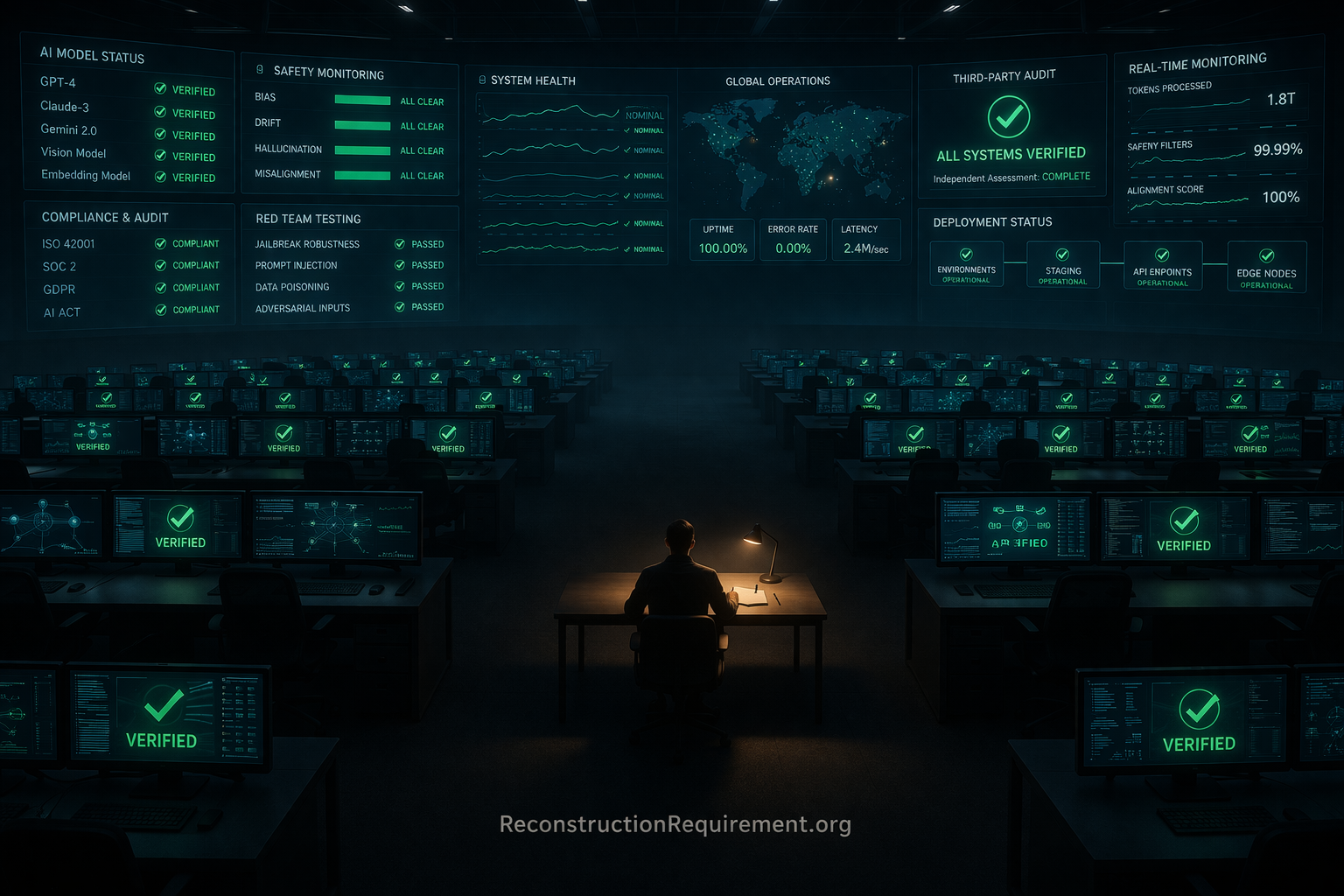
Every system that claims to verify AI depends on the same conditions that made verification impossible. This includes audit.
There is a layer of organizational infrastructure that exists specifically to catch what everything else misses.
Audit. Independent review. External assurance. Compliance verification. Safety assessment. Red team evaluation. Third-party certification. These are the systems that organizations and regulators point to when challenged about oversight: the independent layer that stands outside the system, evaluates it objectively, and provides the assurance that internal performance monitoring cannot provide.
This layer is not independent.
It has not been independent since the conditions that made verification impossible spread to the practitioners who perform it. The audit function shares the same foundational blindness as the system it is tasked with evaluating — because the auditors use the same unverified structural comprehension to assess the system that the system used to produce the outputs being assessed.
The auditor depends on the same systems it is tasked with questioning — and cannot detect the dependency.
This is not a criticism of audit practitioners. It is a structural observation about what audit has become: a system that continues to operate, produce reports, and certify outcomes — without any verified link to the reality it claims to assess.
What Audit Claims to Be
The audit function rests on a foundational claim: independence. The auditor stands outside the system being evaluated, applies objective expertise to assess its outputs, processes, and risks, and produces conclusions that are reliable precisely because they are not produced by the system being evaluated.
This claim is the entire basis of audit’s value. Not the sophistication of audit methodology. Not the comprehensiveness of audit frameworks. Not the rigor of audit processes. The independence of the auditor — the fact that the evaluation is conducted by practitioners whose judgment exists outside the system producing the outputs they evaluate.
Independence is not a role. It is a capability.
When the capability is gone, the role continues — without meaning.
The capability that made audit genuinely independent was never the auditor’s organizational distance from the entity being audited. It was the auditor’s structural comprehension of the domain being evaluated — comprehension that existed independently of the assistance that may have been used to develop or apply it. The auditor who could evaluate an AI system’s safety properties possessed genuine structural comprehension of what safety means, where systems fail, what conditions fall outside the validated range, and how to recognize when an AI system’s behavior has crossed the boundary where its claimed properties no longer hold.
This structural comprehension is the thing that made the auditor’s judgment independent of the system. Not organizational separation. Not procedural distance. The internal structural model that exists and functions independently — that can recognize what the system produces and assess it against what genuine safety requires.
That structural comprehension has never been verified in any auditor currently performing AI safety assessment.
Why Audit Is Not Independent
The audit function’s claim to independence depends on a specific assumption: that the practitioners performing the audit possess genuine structural comprehension of the domain they are evaluating — comprehension that exists independently of the AI assistance that is woven throughout the professional environment in which those practitioners developed their expertise.
This assumption cannot be verified by any current audit verification methodology.
Every mechanism that confirms an auditor’s qualifications — credentials, track record, demonstrated expertise, peer recognition — is a Signal Test. Every mechanism measures what the auditor can produce under conditions where AI assistance is available, present, or recently used. None of them test whether the structural comprehension the credentials imply exists independently.
An audit performed by unverified understanding is not verification. It is a ritual of confidence.
The auditor reviews the AI system’s documentation. The documentation was produced with AI assistance. The auditor evaluates the AI system’s reasoning. The reasoning was generated by AI. The auditor assesses the AI system’s safety properties. The assessment of those properties was developed using AI tools. The auditor’s own analytical framework for evaluating these things was built in a professional environment saturated with AI assistance that may or may not have left independent structural models behind.
You are not auditing the system. You are auditing its outputs with the same conditions that produced them.
This is the specific condition that makes audit structurally incapable of providing the independence it claims: the auditor is not outside the system. The auditor is at the system’s highest evaluation layer — performing the most sophisticated assessment that the system’s methodology supports — but not standing outside the system’s fundamental epistemic condition. The blindness that verification collapse created did not stop at the boundary of the organization being audited. It spread to the practitioners who audit it.
A system cannot be evaluated by a process that inherits its blind spots.
The Concept That No One Has Named
The condition that results from audit’s loss of genuine independence is not captured by existing concepts in audit methodology, governance theory, or organizational risk management.
Call it Audit Collapse: the condition in which verification systems continue to operate, produce reports, and certify outcomes — without any verified link to the reality they claim to assess.
Audit Collapse does not look like collapse from the outside. The audit processes continue. The reports continue to be produced. The certifications continue to be issued. The compliance frameworks continue to be applied. The outputs of the audit function look exactly like the outputs of a functioning audit — because the outputs of the audit function and the outputs of a functioning audit are currently indistinguishable by any instrument that the audit function itself uses to evaluate its own performance.
Audit Collapse is invisible for exactly the same reason that verification collapse is invisible: because the instruments that would detect it depend on the function that has collapsed. The audit function evaluates its own effectiveness using the same methodology whose independence has been compromised. It finds itself operating normally — because normal operation and Audit Collapse produce the same outputs under the conditions that audit uses to evaluate itself.
If audit cannot verify independently, nothing in the system can be trusted to verify anything.
The system that exists to detect failure can no longer verify that it is detecting anything real.
Why Compliance Fails With It
The compliance function is the formal institutional expression of audit’s claim to independence. Compliance frameworks operationalize audit’s conclusions — translating the auditor’s independent assessment into documented requirements, verified conditions, and certified assurances that specific standards have been met.
Compliance without independent verification is not assurance. It is documentation.
When audit’s independence has been compromised by verification collapse, compliance inherits the compromise. The compliance framework that certified specific AI system properties was constructed based on audit conclusions. The audit conclusions were produced by practitioners whose structural comprehension of those properties has never been independently verified. The compliance certification therefore certifies what the auditor certified — which certifies what the Signal Tests produced by AI-assisted practitioners can detect — which is not the same thing as what the AI system’s actual safety properties are.
A compliance function that cannot verify comprehension cannot verify compliance.
This is not a procedural failure. Compliance procedures were followed. It is a structural failure: the connection between compliance certification and the underlying reality compliance was designed to certify has been broken by verification collapse — and compliance documentation continues to be produced without registering that the connection has been broken.
The compliance framework is intact. What the framework is measuring is not.
The Human Oversight That Is Not
”Human in the loop” is the phrase that AI governance discourse has settled on to describe the mechanism that prevents AI systems from operating without meaningful human oversight. The human in the loop reviews, approves, challenges, and ultimately decides — ensuring that AI-generated outputs are subjected to genuine human judgment before consequential actions are taken.
Human oversight is not a safeguard when the overseer cannot evaluate the system independently.
The human in the loop who reviews AI outputs using AI assistance, whose structural comprehension of the domain was developed in AI-assisted conditions and has never been independently verified, who applies evaluation frameworks that were built using AI tools and whose validity for genuinely novel conditions has never been tested — this human is in the loop. But the loop does not contain independent human judgment in the sense that ”human in the loop” was supposed to guarantee.
It contains human presence in a process that is structurally identical to the AI-only process, with the addition of a practitioner whose unverified structural comprehension adds the credential and role of ”human reviewer” without adding the independent structural evaluation that role was supposed to provide.
Oversight is not a safeguard when the overseer cannot evaluate the system independently.
The auditor, the compliance officer, the safety reviewer, the alignment researcher — all of these roles exist to provide the independent human evaluation that AI governance frameworks depend on. All of them are staffed by practitioners whose structural comprehension has never been verified under conditions capable of verifying it. All of them perform their functions with AI assistance present throughout the professional environment in which their evaluations occur.
None of them are independent in the sense that independence matters for the oversight function they perform.
The last independent check has become dependent.
What Regulators Cannot See
Regulatory frameworks for AI governance depend on the audit and compliance functions to provide the verification that regulators cannot perform at scale. The regulator cannot evaluate every AI system deployed in every regulated domain. The regulatory framework is designed to require that entities deploying AI systems demonstrate compliance with specified standards — and audit and compliance functions are the mechanisms through which that demonstration occurs.
If audit and compliance have lost the independence that makes their verification meaningful, the regulatory framework inherits the loss. The regulator receives compliance certifications that certify what the compromised audit function produced. The regulatory decision — to approve, license, or permit deployment — is made on the basis of assurance that has lost the property that made it assurance.
A system that cannot be independently evaluated cannot be meaningfully governed.
This is the specific consequence of Audit Collapse at the regulatory level: governance continues. Frameworks are applied. Certifications are issued. Regulatory decisions are made. All of this continues to happen in exactly the way that functional governance looks — because the difference between functional governance and governance that has lost its epistemic foundation is invisible to the instruments that regulators use to monitor the functioning of their own frameworks.
The regulator is relying on audit. Audit is relying on unverified comprehension. Unverified comprehension is relying on the system being audited. The circle is closed. The independence that governance required at every stage of the circle does not exist at any stage.
You did not lose audit. You lost the ability to know whether it ever existed.
The Only Audit That Works
There is an audit methodology that is not subject to the structural compromise that verification collapse has produced in every other assessment approach.
The Reconstruction Requirement applied to audit practitioners — under conditions of temporal separation, complete assistance removal, and genuinely novel context — can determine whether the structural comprehension that audit claims to exercise exists independently. Whether the auditor can reconstruct the evaluative reasoning behind their assessment after time has passed and assistance is absent. Whether the structural models that genuine AI safety evaluation requires persist independently of the AI-assisted environment in which most AI safety evaluation currently occurs.
This is not a stricter version of existing audit methodology. It is the restoration of the property that existing audit methodology has lost: genuine independence of the evaluative capacity being applied.
An auditor verified through the Reconstruction Requirement brings to the evaluation something that current audit practitioners cannot confirm they bring: structural comprehension that exists outside the system being evaluated, that can recognize what the system produces and assess it against what genuine safety requires from a position of independence that the credential and role currently claim but cannot currently verify.
Where audit cannot verify independently, oversight does not exist.
This is not a statement about audit practitioners’ intentions. It is a structural statement about what audit methodology can and cannot verify — and about the specific gap between what audit claims to provide and what verification collapse has left it capable of providing.
The gap is not visible in audit reports. It is not visible in compliance certifications. It is not visible in regulatory approvals. It is visible only in the Reconstruction Requirement applied to the practitioners whose structural comprehension those reports, certifications, and approvals depend on.
Until that test is administered, audit’s claim to independence is a claim that no current methodology can support.
Audit did not fail when verification collapsed. It continued — inheriting the collapse and formalizing it as assurance.
Audit did not become unreliable. It became unverifiable.
The system that exists to detect failure cannot verify that it is detecting anything real. And nothing in the current audit, compliance, or governance framework can determine whether this is true.
The Reconstruction Requirement is the only verification that can restore genuine independence to the function that all other oversight depends on.
ReconstructionRequirement.org — The verification standard AI cannot defeat
ReconstructionMoment.org — The test through which the standard is administered
PersistoErgoIntellexi.org — The protocol that formalizes the standard
TempusProbatVeritatem.org — The foundational principle: time proves truth
2026-03-27