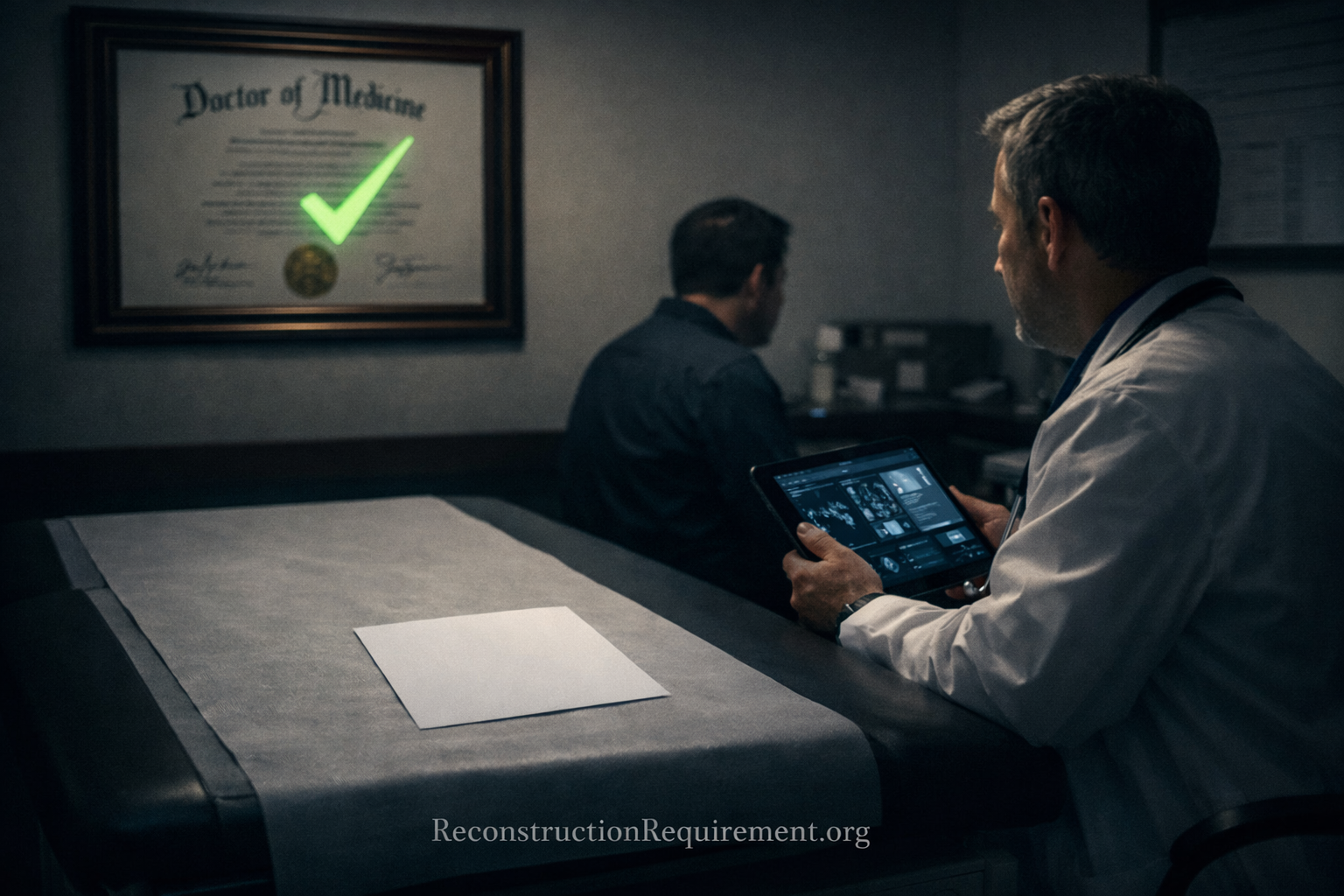
The credential did not change. What it certifies did. And no one — not the institution that issued it, not the practitioner who holds it, not you who relies on it — was told when it happened.
A credential once meant one thing.
That meaning no longer holds.
Not because institutions changed. Not because standards declined. Not because the people who earned those credentials are less capable or less committed. Because the conditions beneath the credential changed — the specific cognitive conditions that once made earning a credential require the thing the credential was supposed to certify.
The credential is still valid. The meaning of validity has shifted.
What a Credential Was
A credential was never a guarantee of perfect performance. It was never a claim that the practitioner would get everything right. It was never an assurance that expertise would function flawlessly under all conditions.
A credential was a claim about something more specific and more foundational: that the practitioner had undergone the formation process through which genuine structural comprehension is built — the sustained encounter with the domain’s difficulty that forces internal models to be constructed — and that through the demands of genuine professional and educational practice, had demonstrated that those models existed.
A credential certified having passed a system that required understanding to pass it.
This was the foundational assumption behind every credential in every domain. Not that the practitioner possessed perfect understanding. That the process of earning the credential required genuine structural comprehension to complete — that the cognitive work of earning the credential and the cognitive work of building structural comprehension were the same cognitive work, and that the credential therefore provided reliable evidence that the structural comprehension it claimed to certify was present.
This assumption made credentials meaningful. Not as guarantees of outcome — credentials were never that. As evidence of formation: that something structural had been built, that the building had been demanded by the credential process, and that what the practitioner brought to professional practice was the residue of genuine cognitive encounter with the domain’s difficulty.
Credentials no longer certify capability. They certify exposure to systems that can produce it.
The Shift That No Institution Announced
The shift did not require any institution to change its standards. It did not require any professional body to revise its requirements. It did not require any educator to alter their curriculum or any examiner to modify their assessments.
The shift occurred because the conditions beneath the credential changed.
When AI assistance became capable enough to produce every signal of genuine structural comprehension without the structural comprehension those signals required, the credential process continued exactly as before — administering the same assessments, evaluating the same outputs, issuing the same certifications. Every component of the credential process remained intact.
What changed was what passing the process required. Before the shift, passing the assessments required producing outputs that could only be produced by doing the cognitive work that builds structural comprehension. After the shift, passing the assessments required producing outputs — which AI assistance could produce without the cognitive work that structural comprehension requires.
The credential still verifies performance. Performance no longer requires structural comprehension.
A credential certifies what can be verified. When what can be verified changes, the credential changes with it — whether or not the credential’s language, requirements, or issuing institution changes at all.
The signal remains. The guarantee is gone. Nothing in the credential indicates the difference.
The Person You Trust
There is a person you trust with something that matters.
Your cardiologist, who reads the imaging and tells you what it means and what must happen next. Your structural engineer, whose stamp is on the building where decisions about safety were made. Your attorney, who told you the contract protected your interests. Your financial advisor, whose recommendations are based on analysis you cannot independently verify.
Each of them holds a credential. The credential is legitimate. It is correctly issued. It certifies exactly what it has always certified.
The question is not whether they are competent. The question is what their credential now guarantees about the kind of competence that matters most: the ability to function when the established framework stops governing, when the AI-generated assessment needs to be recognized as wrong, when the novel situation demands structural comprehension that cannot be borrowed.
Your doctor is certified. That does not mean her clinical reasoning exists independently of the systems that can produce it.
This is not a statement about any individual physician. It is a statement about what the credential verification infrastructure can and cannot determine — and what the credential therefore can and cannot guarantee. The credential was designed to certify structural comprehension. The verification methodology that supports the credential can no longer detect its presence or absence. The credential therefore cannot guarantee what it was designed to guarantee.
This is not a crisis of incompetence. It is a crisis of unverifiability.
We did not lose trust in credentials. We lost what made them trustworthy.
Why the Practitioner Cannot Know Either
The most disorienting aspect of this situation is not that institutions cannot verify structural comprehension. It is that practitioners cannot verify their own.
Genuine structural comprehension and borrowed explanation feel identical from the inside. The physician who has built genuine structural models of clinical reasoning and the physician who has borrowed sophisticated clinical analysis both experience the same internal signal when they reach a clinical conclusion: the feeling of understanding, the coherence of the reasoning, the satisfaction of having arrived at a defensible answer.
This internal signal was once a meaningful guide. It was calibrated through repeated genuine cognitive encounter with difficulty — through the experience of being wrong in ways that forced structural model revision, through the accumulated friction that made the signal of genuine comprehension distinguishable from the signal of confident retrieval.
In an environment where AI assistance has made genuine cognitive encounter with difficulty optional, the calibration is gone. The internal signal of understanding fires without the repeated encounter with wrongness that once made it reliable.
The practitioner who has developed their capabilities in AI-assisted conditions has no reference point for what genuine structural comprehension feels like in contrast to borrowed explanation — because they have never experienced the contrast. They cannot know whether their confidence is grounded in structural models that exist independently or in patterns of AI-assisted performance that have never been tested for independence.
The credential holder cannot tell. The institution that issued the credential cannot tell. The verification infrastructure that supports the credential cannot tell.
Nobody in the chain of trust that credentials are supposed to support can tell what the credential now actually certifies.
The Domains Where This Is Not Abstract
The credential gap is not equally consequential in all domains. It concentrates where the novelty threshold is highest — where the situations that fall outside the established framework are most consequential, most likely to arrive, and most likely to require the specific structural comprehension that the credential was supposed to certify and that no current verification methodology can confirm is present.
Medicine. The physician practicing in a rapidly evolving domain — where AI diagnostic systems are generating assessments for presentations that fall outside their validated range, where the correct response requires recognizing that the AI-generated differential has stopped governing — needs structural comprehension that persists independently. The credential certifies that they completed a formation process. It no longer certifies that the formation process produced the independent structural comprehension that this moment requires. When the AI system is wrong in a way that only independent structural comprehension can recognize, the credential provides no evidence that the recognizing capacity exists.
Law. The attorney practicing in a domain where precedent is evolving faster than any human can track without AI assistance — where the correct legal argument requires constructing novel doctrinal reasoning from underlying principles, where the AI-generated legal analysis has moved beyond its validated range — needs structural comprehension of doctrine that exists independently. The credential certifies demonstrated legal reasoning under examination conditions. It does not certify that the reasoning can be reconstructed when the AI systems that assisted its demonstration are removed and the situation demands what no established precedent anticipated.
Engineering. The structural engineer whose design analysis depends on AI modeling systems — whose professional judgment is applied to outputs that AI systems generate — needs structural intuitions about failure conditions that exist independently of the modeling systems. The credential certifies that the engineer satisfied professional formation requirements. It does not certify that the structural intuitions the credential implies were developed through genuine cognitive encounter rather than through AI-assisted analysis that was never tested for independence.
AI development. The safety researcher whose safety assessments determine what systems are deployed needs structural comprehension of AI failure modes that persists when the AI assistance that informed those assessments is removed. The credential certifies that the researcher completed the recognized formation in the field. It does not certify that the structural comprehension of AI systems the credential implies exists independently — the specific independence that safety assessment requires when the situation falls outside what existing safety frameworks anticipated.
In each case, the credential is real. The formation it certifies occurred. What the credential cannot certify is whether that formation produced structural comprehension that persists — the specific property that the credential was always designed to imply and that is now the only property that differentiates genuine professional competence from AI-assisted performance that will fail at the novelty threshold.
The Institutional Silence
The institutions that issue credentials are not unaware that AI assistance has changed how practitioners develop their capabilities. They are aware of it in the way that organizations are aware of changes whose implications they have not yet fully confronted.
The conversation has been about AI assistance in assessment — whether practitioners should be allowed to use AI during examinations, how to detect AI-assisted cheating, whether examination formats should adapt to acknowledge AI’s presence. This is the conversation that is happening.
The conversation that is not happening is the structural one: whether the credential process, even administered with perfect detection of AI assistance during the examination itself, still produces reliable evidence that the structural comprehension the credential claims to certify was built during the formation process.
This conversation is not happening because it leads to a conclusion that is institutionally uncomfortable: that the answer is no, and that restoring the credential’s evidentiary value requires adding a verification component — temporal separation, assistance removal, novel reconstruction — that existing assessment infrastructure is not designed to provide.
The credential did not become less rigorous. It became disconnected from the thing it was supposed to measure.
No institution announced this. No professional body issued a correction. The credentials continue to be issued, presented, and relied upon — because there is no alternative institutional infrastructure that fills the function credentials have always filled, and because the specific change that made the credential’s evidentiary value uncertain is invisible to every monitoring system that institutions use to evaluate the reliability of their own certification processes.
What the Credential Still Provides
The credential collapse is not total. The credential provides real information — it is not worthless. What it provides is evidence of something more limited than what it has always claimed to provide.
It provides evidence that the practitioner completed the formation process as it was administered. It provides evidence that the practitioner could satisfy the assessment requirements under the conditions in which they were evaluated. It provides evidence that the credential-issuing institution found the practitioner’s performance satisfactory by the standards the institution applies.
What it no longer provides is evidence that genuine structural comprehension was built — that the formation process produced independent structural models that persist when assistance ends, that transfer to genuinely novel contexts, that can recognize when established reasoning has stopped governing.
This is not a small limitation. The property the credential no longer certifies is precisely the property that professional competence was always designed to guarantee: the structural comprehension that makes expertise genuinely protective in the situations where it matters most and that distinguishes genuine professional judgment from sophisticated performance of professional judgment.
If it cannot be reconstructed without assistance, it was never understood. This applies to every credential. It applies most urgently where the stakes are highest.
The Verification That Restores the Credential’s Meaning
The credential can mean what it was designed to mean. The path to restoring that meaning is specific and available.
The Reconstruction Requirement applied to professional formation and credential verification adds the one component that currently missing verification methodology cannot provide: confirmation that the structural comprehension the credential claims to certify persists independently — that it survives temporal separation, that it can be reconstructed without assistance, that it transfers to genuinely novel contexts.
A credential verified through the Reconstruction Requirement certifies something real: not just that the practitioner completed a formation process and satisfied assessment requirements, but that the formation process produced structural comprehension that exists and functions independently. The credential becomes evidence of what it always claimed to be evidence of.
A credential that cannot be supported by this verification is not necessarily evidence of absent structural comprehension. It is evidence of unverified structural comprehension — which is a different thing, and which has different implications for the institutions and individuals who rely on the credential.
The credential still looks the same. Its meaning does not have to remain different.
If credentials no longer guarantee understanding, what does?
The answer is not a better credential. It is verification that the credential’s claim is real — that what the credential implies about structural comprehension can be demonstrated under the conditions that distinguish structural comprehension from its simulation.
The Reconstruction Requirement is that verification. Not an addition to the credential. The evidence that makes the credential mean what it was always designed to mean.
ReconstructionRequirement.org — The verification standard AI cannot defeat
ReconstructionMoment.org — The test through which the standard is administered
PersistoErgoIntellexi.org — The protocol that formalizes the standard
TempusProbatVeritatem.org — The foundational principle: time proves truth
2026-03-26