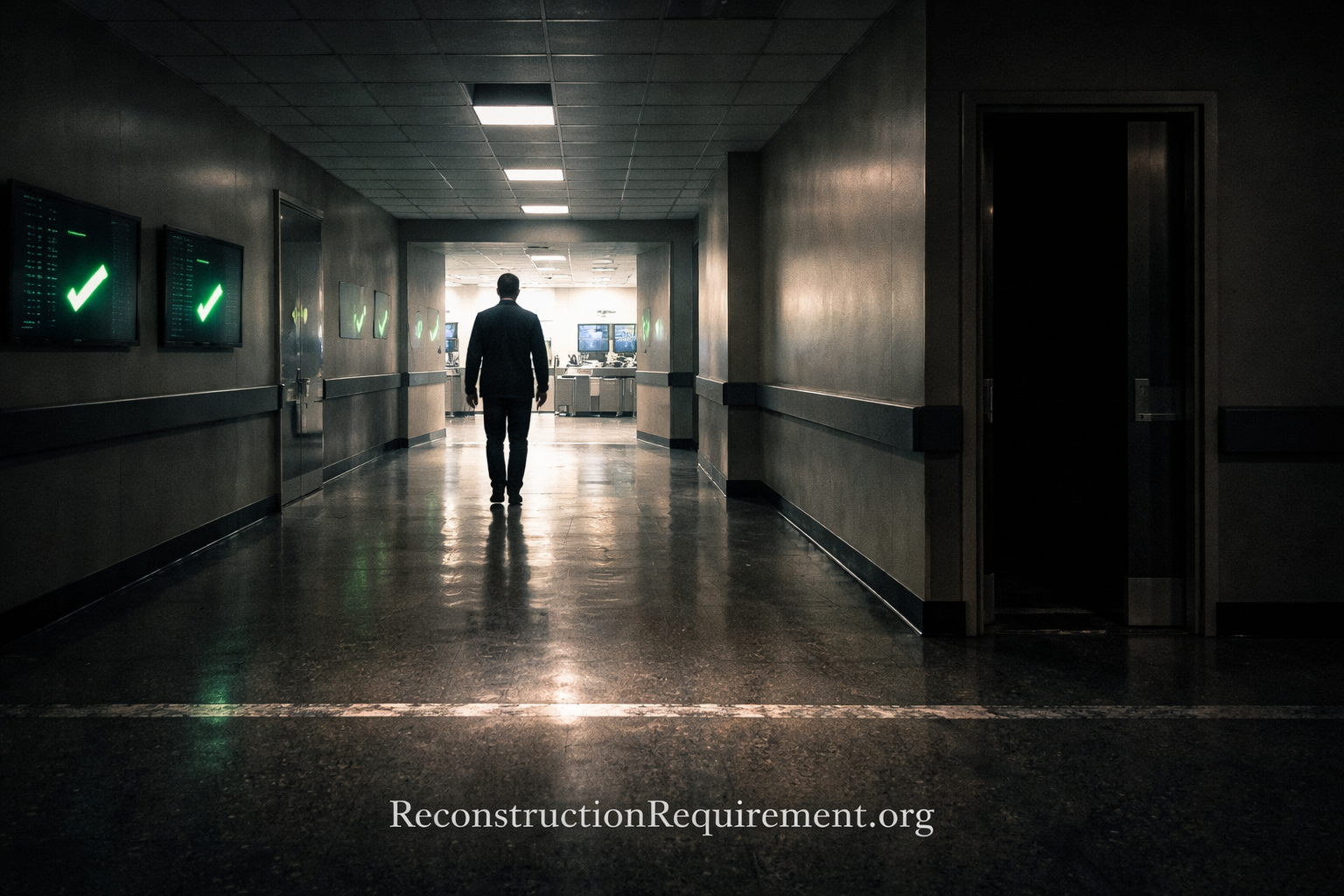
There is a moment when the difference becomes visible. It does not occur during normal operation. It occurs when normal operation ends.
Everything works.
The physician reviews the case and the reasoning is coherent. The engineer evaluates the structure and the analysis is sound. The safety researcher assesses the AI system and the evaluation is thorough. The attorney analyzes the contract and the conclusion is defensible. The organization operates and the outputs are correct.
Everything works — until the moment it matters.
Normal operation conceals the difference between structural comprehension and borrowed explanation because normal operation is specifically the domain where borrowed explanation performs identically to genuine structural comprehension. The outputs are correct. The credentials are valid. The evaluations are satisfactory. Every signal available under normal operating conditions confirms that the system is functioning as designed.
The novelty threshold is the moment when normal operating conditions end.
What the Novelty Threshold Is
The novelty threshold is the point at which borrowed explanation fails and only structural comprehension remains.
Not a gradual degradation. Not a partial failure that produces warning signals and allows correction. A threshold — a specific point of divergence at which the borrowed explanation that performed identically to genuine structural comprehension under the conditions it covered encounters conditions it cannot cover, and the difference between what was built and what was borrowed becomes simultaneously visible and consequential.
Before the threshold, the distinction cannot be observed. Both produce correct outputs. Both pass evaluations. Both satisfy the assessment systems that exist to verify performance. The practitioner with genuine structural comprehension and the practitioner whose explanation was always borrowed present identical surfaces to every instrument that measures surfaces.
At the threshold, only what is real survives.
The novelty threshold is not an edge case. It is the moment every system eventually reaches — the specific point at which the situation falls outside the distribution that AI-assisted performance navigated successfully, where established patterns fail, where the correct response requires recognizing that the framework has stopped governing, where what no training distribution anticipated arrives and demands what no borrowed explanation can provide.
Every domain has a novelty threshold. Most do not know where it is.
This is not a failure in a system. It is a property of all systems built on unverified understanding.
What Expertise Actually Exists For
The fundamental misunderstanding of expertise in the normal case is that expertise is what makes normal operations excellent. That the physician’s expertise is what produces accurate diagnoses in routine presentations. That the engineer’s expertise is what produces sound analysis in standard cases. That the attorney’s expertise is what produces coherent arguments in established legal territory.
This is not what expertise is for.
Expertise is not tested in the normal case. It exists for the moment when the normal case stops applying.
The routine presentation can be handled by pattern recognition operating within a familiar distribution — by the AI-assisted performance that the credential process has certified without verifying whether the structural comprehension the certification implies actually exists. The standard case, the established legal territory, the known structural parameters — all of these can be navigated by borrowed explanation performing as structural comprehension, because the borrowed explanation was designed for exactly this distribution and performs perfectly within it.
The novel presentation cannot be handled this way. The structural failure mode that no calculation anticipated cannot be identified by pattern extension within a familiar distribution — it requires a structural model that grasps the mechanism beneath the calculations, that can recognize when the mechanism has stopped governing, that can identify the conditions under which the established analysis has become wrong.
Expertise is not what works when things are known. It is what remains when nothing known applies.
This is the specific definition of structural comprehension that the credential was always designed to certify — not the ability to perform correctly under normal conditions, but the ability to recognize when normal conditions have stopped applying. The capacity to identify when the framework fails. The structural model that adapts when the pattern cannot repeat. The genuine understanding that persists when everything borrowed has stopped working.
This is what the novelty threshold demands. And this is what verification has stopped verifying.
Why the Threshold Cannot Be Detected Before It Is Crossed
The novelty threshold cannot be detected before it is crossed.
This is not a limitation of current monitoring technology that better instruments could overcome. It is a structural property of the threshold itself — a consequence of what the threshold is and what it reveals.
The threshold is invisible during normal operations because the condition that makes it visible — the divergence between genuine structural comprehension and borrowed explanation — does not occur until the situation falls outside the distribution where both perform identically. Before the threshold, every monitoring system reports normal operation because normal operation is what is occurring. The borrowed explanation is performing correctly. The outputs are satisfactory. The assessments are passing. The signals that monitoring systems depend on are all within expected ranges.
The threshold does not arrive with warning. It arrives with consequence.
When the novel situation appears, it does not announce itself as the moment of threshold crossing. It appears as a case — a presentation, a structural configuration, a legal dispute, a system behavior, a professional situation — that seems like other cases while differing from them in the specific way that matters most: that the established framework has stopped governing, that the correct response requires recognizing the framework’s failure rather than extending the framework, that the structural comprehension required to navigate it either exists independently or does not exist at all.
The threshold is not an event you observe. It is an event you discover — after failure.
By the time the failure is visible — by the time the wrong diagnosis is made, the structural flaw missed, the legal argument constructed on a framework that no longer applied, the AI safety assessment completed without recognizing the failure mode the evaluation methodology could not anticipate — the threshold has already been crossed. The discovery occurs at the moment of consequence, not at the moment of approach.
You will trust the system most precisely when it is about to fail. The moment you are most certain is the moment you are most exposed.
This is the specific property of the novelty threshold that makes verification so consequential: the threshold is approached with full institutional confidence. The practitioner whose structural comprehension was never built approaches the threshold indistinguishable from the practitioner who built it — indistinguishable to external observation, indistinguishable to institutional assessment, indistinguishable to the practitioner themselves. The internal signal of competent professional practice fires in both cases. The credential is valid in both cases. The evaluation record is satisfactory in both cases.
The difference reveals itself at the threshold, where it is simultaneously the most consequential and the least correctable.
The Distribution That Hides the Threshold
Understanding why the novelty threshold is invisible during normal operation requires understanding what normal operation is — and what it is not.
Normal operation is the range of situations that fall within the distribution that AI-assisted professional formation has covered. The presentations that fit the established differential. The structural configurations within the validated parameters. The legal situations that precedent governs. The AI system behaviors within the validated range. The professional situations that training anticipated.
Within this distribution, AI-assisted performance and genuine structural comprehension produce identical outcomes. Not similar outcomes — identical ones. The same conclusions, the same reasoning quality, the same professional judgment, the same response to the same challenges. If normal operation were all that professional practice required, the verification collapse would be inconsequential. Both types of performance would produce the same outcomes forever.
Normal operation is not all that professional practice requires. It is the baseline — the routine, the expected, the anticipated. And every professional domain contains, embedded within its practice, the specific situations that fall outside the baseline. The presentations that do not fit. The configurations that exceed validated parameters. The disputes that fall between precedents. The system behaviors that exceed the evaluation framework’s range.
These situations are not rare in the sense of being statistical outliers. They are the situations that define what professional expertise is for. Every professional domain was constructed around the recognition that situations arise that require more than pattern recognition within the established distribution — that require the structural comprehension to recognize when the established distribution has stopped governing.
The distribution hides the threshold because the distribution is where everything works. The threshold is where the distribution ends.
What Happens at the Threshold
At the novelty threshold, borrowed explanation does not fail gradually. It does not produce increasingly uncertain outputs that signal the approach of its limit. It produces confident, coherent, professionally appropriate outputs right up until the moment it encounters conditions it cannot cover — and then it fails completely, producing confident, coherent, professionally appropriate outputs that are wrong in ways that only structural comprehension can recognize.
This is the specific failure mode that makes the threshold so dangerous. A failure that produces uncertainty signals allows correction — the practitioner recognizes uncertainty, escalates, seeks additional verification, acts cautiously. A failure that produces confident, coherent, professionally appropriate wrong answers does not allow correction — because the practitioner cannot distinguish the wrong answer from the correct one. The internal signal of professional competence fires in both cases.
The practitioner with genuine structural comprehension at the threshold recognizes the novel situation for what it is. The clinical presentation that does not fit the standard differential — the specific combination of factors that suggests the differential itself is wrong. The structural configuration that falls outside validated parameters — the failure mode that the calculations implicitly assumed could not occur. The legal situation whose resolution requires constructing novel doctrinal argument from underlying principles rather than extending established precedent.
The practitioner with borrowed explanation at the threshold does not recognize any of this. The borrowed explanation extends the established pattern. The established pattern does not apply. The extension produces a wrong answer that looks like a correct one. And the practitioner has no structural model that would allow them to recognize the difference.
The novelty threshold is the moment that reveals whether structural comprehension exists — or never did.
Why Every Domain Is Already at Risk
The novelty threshold exists in every professional domain. Its specific location — the specific types of situations that cross it — varies by domain. But its existence is universal, because the existence of situations that fall outside established distributions is universal.
Medicine. Novel presentations, rare combinations of symptoms, atypical disease progressions, patients whose characteristics fall outside the populations the training distribution covered. These are not rare in clinical practice. They are the routine feature of medicine at its most demanding — the cases that require the structural comprehension that clinical training was designed to build.
Law. Novel legal questions, disputes that arise in the gaps between precedents, regulatory environments that have evolved faster than the doctrine that governs them, cases whose resolution requires constructing arguments from underlying principles rather than applying established rules. These are not rare in legal practice. They are the cases that require the structural comprehension of doctrine that legal education was designed to develop.
Engineering. Failure modes that fall outside validated parameters, structural configurations that existing calculations do not anticipate, load combinations that exceed the assumptions implicit in established design methodologies. These are not rare in engineering practice. They are the failures that require the structural intuitions that engineering formation was designed to build.
AI development. Novel failure modes in AI systems, behaviors that emerge in deployment conditions that evaluation methodologies did not anticipate, safety properties that do not hold in domains the systems were not designed for. These are not rare in AI development. They are the situations that define what AI safety work exists for — and that require the structural comprehension of AI systems that AI development formation was supposed to produce and that verification cannot currently confirm exists.
By the time you know you needed structural comprehension, it is already too late to build it.
At the threshold, there is no time to become competent. Only to discover whether you were.
The threshold does not provide preparation time. It does not arrive during calm periods when structural comprehension can be developed through deliberate encounter with difficulty. It arrives at the moment of professional demand — at the case, the failure, the dispute, the system behavior — when what was never built cannot appear.
The Only Preparation That Works
There is one preparation that works for the novelty threshold. Not better Signal Tests. Not more comprehensive training. Not more rigorous credential requirements administered through the same contemporaneous assessment methodology.
The only preparation that works is verification that structural comprehension was built before the threshold arrives — that the practitioner, under conditions of temporal separation, assistance removal, and genuine novelty, can demonstrate that the structural model exists and functions independently.
This verification does not prepare practitioners for specific novel situations. No preparation can — novelty is by definition the situation that preparation did not anticipate. What it does is confirm that the structural model required to navigate novelty exists: that the practitioner can recognize when established frameworks have stopped governing, that the reasoning can be rebuilt when the familiar patterns fail, that the expertise that exists for the threshold moment actually exists rather than being borrowed explanation that will fail precisely at the moment it is most relied upon.
The Reconstruction Requirement is not verification that practitioners can handle the specific threshold situations they will encounter. It is verification that the structural comprehension required to handle any threshold situation — the independent structural model that recognizes framework failure and generates reasoning beyond the established distribution — was built and persists.
Where reconstruction has not been verified, the threshold will reveal it.
The threshold will arrive. It is not conditional. Every professional domain contains the situations that exceed the established distribution. Every practitioner who operates in domains where expertise matters will encounter them. Every organization that deploys practitioners in high-consequence domains will reach the moment when the novel situation arrives and the question of whether structural comprehension exists or was always borrowed becomes simultaneously answerable and consequential.
The difference between those who verified and those who did not will not be visible before that moment. It will be complete at that moment.
Before the threshold, everything works. At the threshold, only what was built survives.
The novelty threshold cannot be bypassed. It cannot be deferred indefinitely. It cannot be made less consequential by better performance during normal operation.
It can only be prepared for — by verifying, before it arrives, that the structural comprehension it demands actually exists.
The Reconstruction Requirement is that preparation. Not a prediction of what novelty will require. A verification that the capacity to meet it is real.
If it cannot be reconstructed without assistance, it was never understood. The threshold will reveal this whether or not the verification was administered.
ReconstructionRequirement.org — The verification standard AI cannot defeat
ReconstructionMoment.org — The test through which the standard is administered
PersistoErgoIntellexi.org — The protocol that formalizes the standard
TempusProbatVeritatem.org — The foundational principle: time proves truth
2026-03-26