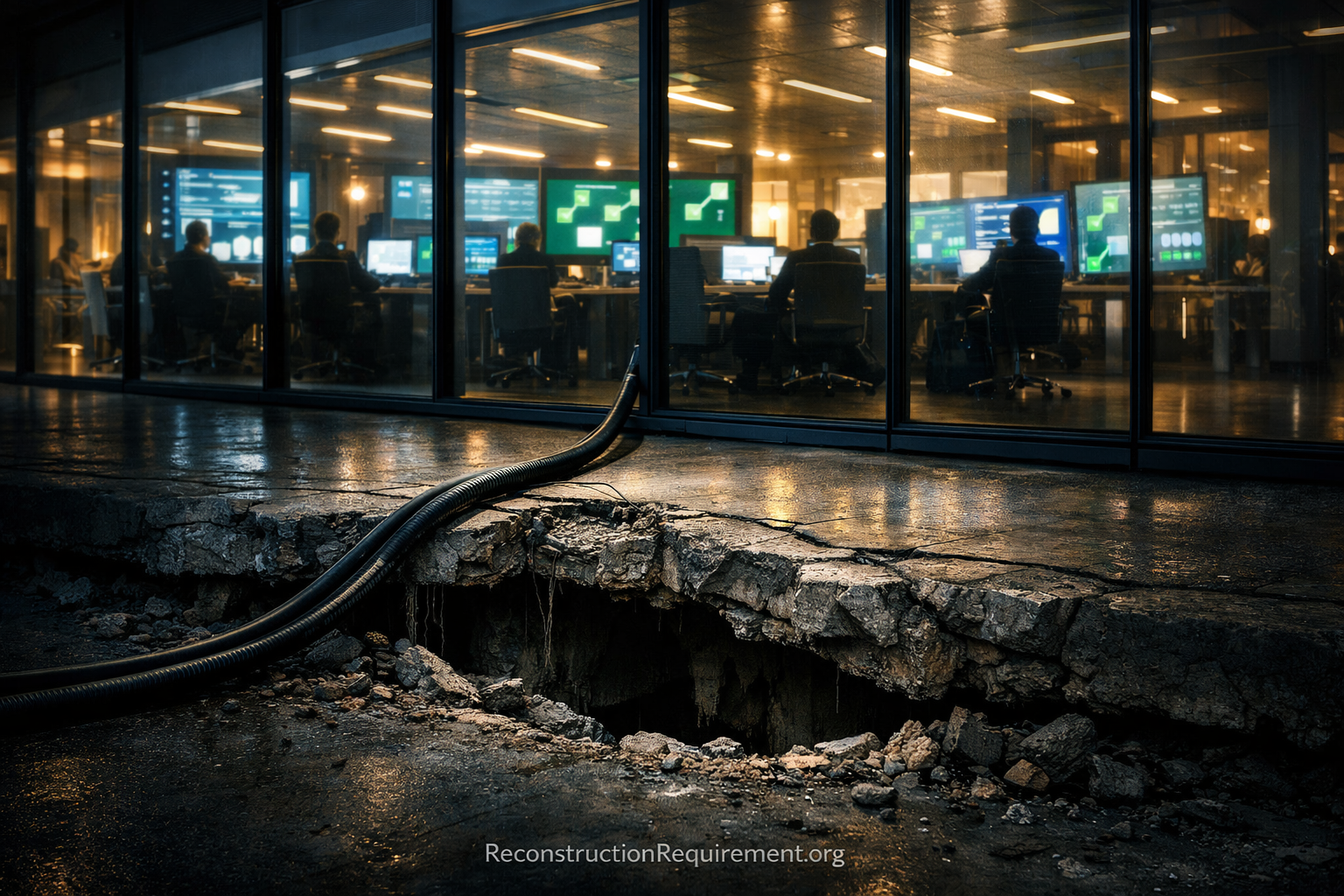
There is a date in your organization’s history after which it could no longer function without AI. That date has already passed. You do not know when it was.
There was no announcement.
No governance trigger. No executive decision that marked the transition. No system alert that indicated something irreversible had occurred. The AI tools were adopted where useful, expanded where effective, integrated where they accelerated work that needed to be done. Productivity increased. Outputs improved. Processes accelerated. Decisions were reached faster and with more supporting analysis than before.
Everything worked.
Nothing signaled that the organization had crossed a threshold it could not cross back.
Dependency did not arrive as a decision. It emerged as a condition.
The Distinction That Changes Everything
Organizations distinguish between tools they use and infrastructure they depend on. The distinction matters because it determines what happens when the system is removed.
A tool extends capability. The organization that removes a tool can still perform the functions the tool assisted — more slowly, less efficiently, with more effort. The capability existed before the tool. It exists after the tool. The tool is an augmentation of something that persists independently.
Infrastructure is different. Infrastructure does not augment a capability that exists independently. It replaces the mechanism through which the capability was produced. The organization that removes infrastructure does not return to a slower version of its previous state. It discovers that the previous state no longer exists — that the organizational capacity the infrastructure was supposed to extend has eroded during the period in which the infrastructure did the work.
This is the transition that AI has produced in every organization that has integrated it meaningfully: from tool to infrastructure. Not because AI became technically irreplaceable. Because the evaluative capacity required to operate without it — the internal structural models that grounded organizational decision-making before AI assistance was available — eroded during the period in which AI assistance made their continuous exercise unnecessary.
The organization did not lose its capability because AI replaced it. The organization lost its capability because AI made exercising it unnecessary — and capabilities that are not exercised do not persist.
Dependency is not the presence of the system. It is the absence of what the system replaced.
Why the Transition Is Invisible
Every monitoring system organizations use to evaluate their own performance measures outputs. Output quality, decision accuracy, process efficiency, error rates, performance against benchmarks — all of these are measurements of what the organization produces. None of them measure what the organization is capable of producing independently.
During the transition from tool to infrastructure, outputs remain stable or improve. The AI assistance that is gradually substituting for independent evaluative capacity does not degrade the outputs it produces — it produces the same quality or better. There is no signal in the output record that indicates the transition is occurring, because the transition specifically is the period during which outputs are maintained or improved while the independent capacity that once produced them erodes.
Organizations measure performance. They do not measure independence.
This is why the transition is invisible: every instrument that could detect it depends on outputs that the system maintains. There is no external reference point. No independent baseline. No measurement that confirms whether the organization still possesses the structural capacity it once had independently.
The instruments that would need to detect the transition are the same instruments that the system whose presence defines the transition continues to produce correctly.
The organization becomes dependent without observing the process that made it so — because the process specifically is the period during which everything observable continues to appear normal.
The Erosion Mechanism
Dependency is not caused by adoption. It is caused by what adoption gradually makes unnecessary.
Every time AI assistance completes a reasoning step that would otherwise require genuine structural evaluation — fills a conceptual gap, extends a pattern, resolves an ambiguity, generates an analysis, produces a justification — it performs cognitive work that would otherwise have been performed by the organizational practitioners whose structural comprehension that work requires.
This is not a problem with the assistance. The assistance is doing what it is designed to do: producing correct outputs efficiently. The problem is a consequence of the assistance doing its work well: the cognitive work it performs is work that, when performed by human practitioners over time, builds and maintains the structural comprehension that genuine professional evaluation requires.
When AI performs that work, practitioners evaluate its outputs rather than performing the underlying cognitive work themselves. The evaluation is genuine — practitioners assess quality, flag inconsistencies, approve or reject conclusions. But evaluation of AI outputs is not the same cognitive work as producing those outputs independently, and it does not build or maintain the same structural models.
Over time, the structural models that practitioners once built through performing the cognitive work that AI now performs begin to erode through disuse. Not suddenly. Not visibly. Not through any signal that monitoring systems detect. Through the specific mechanism through which all cognitive capacities that go unexercised erode: gradual unavailability that is invisible until tested.
The organization retains the appearance of evaluative capacity — the ability to produce reasoning, assess outputs, justify decisions. What it loses is the independent structural foundation that made those activities reliable without assistance.
The system continues to function. The capacity beneath it does not.
An organization that cannot function without AI cannot verify the systems it depends on.
The Point No One Measures
There is a specific point in every organization’s AI integration history at which dependency becomes structurally complete — the point after which the independent evaluative capacity that existed before AI adoption can no longer be recovered without deliberate reconstruction effort.
This point is not observed. It is not measured. It does not appear in any governance record or performance report. It occurs within a period during which all observable indicators show normal or improved performance, and it produces no signal that any monitoring system is designed to detect.
Before this point, dependency is reversible. The organization that removed AI assistance and invested in deliberate practice of independent evaluation could recover the structural capacity that assisted operations made unnecessary. The recovery would be costly and time-consuming, but the capacity could be rebuilt.
After this point, removal does not restore the prior state. It exposes the absence of the prior state. The organization discovers that the structural capacity required to function without assistance was not preserved during the period of assisted operation — that the prior state no longer exists and cannot be recovered through the simple removal of the system whose presence substituted for it.
This is the point that no instrument in any organization currently measures. Not because it is unmeasurable in principle — the Reconstruction Requirement provides the methodology for measuring it. But because no organization has yet implemented the measurement that would reveal where this point falls, whether it has already been passed, and what the organization would find if the system were removed.
Dependency is a historical fact that no instrument has measured.
What Organizations Cannot Currently Know
Every organization that has meaningfully integrated AI into its evaluative processes is operating with a specific uncertainty that its current monitoring infrastructure cannot resolve: whether the evaluative capacity it believes it possesses exists independently of the AI assistance that is present throughout its exercise.
The organization cannot know this from its performance record. Correct outputs under assisted conditions are not evidence of independent evaluative capacity — they are evidence of what the organization and its AI assistance can produce together, which is not the same measurement.
The organization cannot know this from its practitioners’ confidence. Practitioners who have developed their evaluative capacities in AI-assisted environments experience the same internal signal of professional competence as practitioners who developed those capacities independently — because the internal signal does not distinguish between comprehension that exists independently and comprehension that requires assistance to function.
The organization cannot know this from its governance processes. Every governance mechanism that assesses reasoning quality, evaluates analytical sophistication, and approves decision justifications is a Signal Test — it measures what can be produced under assisted conditions, which is not evidence of what exists independently.
What every organization deploying AI at scale currently cannot determine is the answer to the most consequential question about its own operational integrity: if the AI assistance were removed, would the structural evaluative capacity required to maintain its critical functions still exist?
The answer is somewhere in the organization’s history — at the date that has already passed, in the transition that produced no signal, in the erosion that no instrument measured. But the answer is not accessible through any monitoring system the organization currently operates.
The Failure Mode of Invisible Dependency
Organizational dependency does not fail during normal operation. Every AI-assisted decision within the established distribution — every analysis that fits established patterns, every conclusion that falls within the validated range, every judgment that the assistance was trained to support — continues to produce correct outputs whether the underlying independent evaluative capacity exists or not.
The failure occurs at the boundary.
When the organization encounters a situation that requires independent evaluation — when the AI-generated analysis must be assessed against the structural comprehension of practitioners who can evaluate it without assistance, when the novel situation falls outside the distribution the assistance was designed to handle, when the system itself must be evaluated by practitioners whose structural models exist independently — the dependency becomes visible and consequential simultaneously.
The organization that has crossed the dependency threshold discovers at this moment that the capacity it assumed it possessed — the independent structural comprehension that its practitioners’ credentials, its governance processes, and its performance record all implied — does not exist in the form required. Not because anyone chose for this to happen. Because no instrument measured the erosion that made it inevitable.
This is not the failure mode of a system. It is the failure mode of an organization that cannot tell whether its system is correct — because it no longer possesses the independent structural capacity to make that determination.
The Measurement That Reveals the Dependency
There is one way to determine whether an organization has crossed the dependency threshold.
Not by evaluating outputs. Not by assessing performance. Not by reviewing decision quality under conditions where AI assistance is present throughout. All of these measure the organization within the dependency.
The only measurement that reveals dependency is the one that tests the specific capacity whose erosion created it: whether organizational practitioners can reconstruct the evaluative reasoning they exercise under AI assistance independently — after temporal separation, with assistance completely removed, in contexts that genuinely differ from those in which AI assistance was present.
This is the Reconstruction Requirement applied at the organizational level: not verification that individual practitioners have building structural comprehension, but verification that the organization possesses the structural evaluative capacity required to function independently of the assistance it has integrated.
The answer this test produces is the most consequential information any organization deploying AI at scale can possess: the actual location of the dependency threshold in its own operational history — whether it has been passed, how completely, and what independent capacity still exists that can be preserved and restored.
Without this information, the organization operates with a specific uncertainty that its current monitoring infrastructure cannot resolve and that it cannot resolve through any expansion of Signal Test methodology: whether the evaluative capacity it believes it possesses is real or whether it exists only within the dependency that has made its independent exercise unnecessary.
What This Means Now
Every organization that has meaningfully integrated AI has passed through the transition this article describes. Some are early in the transition, where independent evaluative capacity still exists but is becoming less exercised. Some are in the middle, where the erosion is proceeding but the capacity could still be recovered with deliberate effort. Some have passed the dependency threshold, where recovery would require reconstruction rather than exercise of existing capacity.
You did not decide to depend on AI. You lost the ability not to.
No organization currently knows which of these conditions describes it. The monitoring infrastructure that would reveal the answer does not exist in any organization’s current operational framework.
This is not a statement about organizational negligence. It is a statement about what Signal Test infrastructure can and cannot detect, and about the specific gap between what organizations believe about their own evaluative capacity and what the Reconstruction Requirement would reveal.
The gap will not close through continued AI integration. It will not close through improved governance. It will not close through better Signal Tests administered under assisted conditions.
It will close only when organizations implement the measurement that reveals it — and act on what that measurement shows.
There is a date in your organization’s history after which it could no longer function without AI.
That date has already passed.
You do not know when it was.
And nothing in your current infrastructure can tell you. Because the system you depend on is the system you would need to question.
Dependency is not what happens when AI becomes necessary. It is what happens when the capacity to function without it disappears — silently, without signal, and long before the organization discovers that it is gone.
The Reconstruction Requirement is the only measurement that can locate the dependency threshold — and the only preparation that remains available before the system must be evaluated without itself.
ReconstructionRequirement.org — The verification standard AI cannot defeat
ReconstructionMoment.org — The test through which the standard is administered
PersistoErgoIntellexi.org — The protocol that formalizes the standard
TempusProbatVeritatem.org — The foundational principle: time proves truth
2026-03-27